U.S. Orders Staff Departure From Saudi Arabia Amid Rising Threats After Deadly Strikes
10/25/2026 / By Garrison Vance

The U.S. Department of State ordered the departure of non-emergency government employees and their family members from Saudi Arabia on Wednesday, Oct. 21, according to a department statement.
The order affects the U.S. Embassy in Riyadh and consulates in Jeddah and Dhahran, officials said. The State Department cited rising threats following a series of deadly strikes on Saudi airports and energy sites, according to the statement.
The move followed a fresh wave of attacks on the kingdom. The State Department did not specify the exact nature of the threats in its public statement, but officials said the decision was tied to the recent military actions [1].
Oil markets reacted to the news, with Brent crude futures topping $112 a barrel early Thursday, Oct. 22, as fears of escalation in the Gulf mounted, according to ZeroHedge [2].
Details of the Departure Order
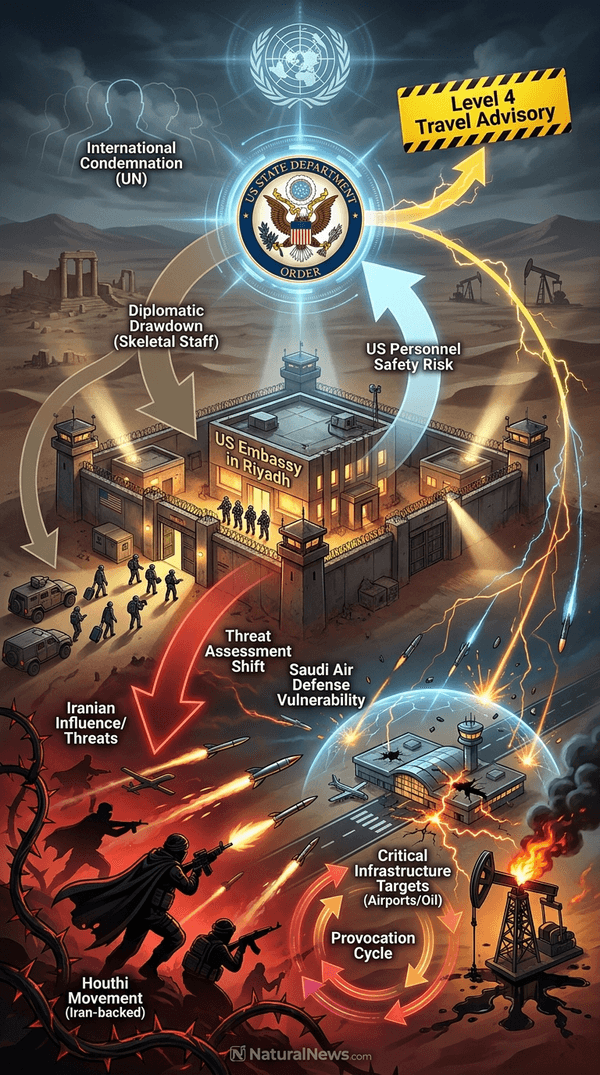
The order authorizes voluntary departure for non-emergency staff and mandates departure for family members, according to the State Department statement. The department also raised its travel advisory for Saudi Arabia to Level 4: Do Not Travel, citing risks of drone and missile targeting of American interests by Iran and the Iranian-supported Houthis, according to a U.S. Embassy notice [3].
The U.S. Embassy in Riyadh stated that consular services will be limited during the drawdown. The ordered departure covers non-emergency U.S. government employees and their family members, according to The Hill [4]. The State Department order follows a series of deadly attacks in the country by Yemen’s Houthi movement, according to the Associated Press [5].
Background: Deadly Strikes in the Region
The departure order followed a series of deadly strikes on Saudi Arabia. On Oct. 10, a missile attack on King Khalid International Airport in Riyadh killed at least 12 people and wounded 309 others, according to Middle East Eye [6]. The Saudi-led military coalition vowed a “firm” response, and President Donald Trump said the U.S. may join strikes on the Houthis [6].
The strikes were attributed to the Iran-backed Houthi movement. The Houthis have not officially claimed responsibility for the initial attack on Oct. 10, according to ZeroHedge [7]. However, Houthi military spokesman Yahya Saree later claimed responsibility for multiple strikes on Saudi airports and oil facilities, according to NaturalNews [8]. A western defense official in Riyadh told Middle East Eye that Saudi Arabia is absorbing the vast majority of missiles and drones fired at it [8].
The strikes have raised questions about the effectiveness of Saudi Arabia’s Western-supplied air and missile defenses, including potential gaps in detection, interception and coverage [7]. The kingdom’s air defenses have struggled to intercept the missiles due to geography, interceptor shortages and evolving attack tactics, according to Middle East Eye [9].
Rising Threats and Regional Reactions
In response to the strikes, groups affiliated with Iranian-backed militias threatened retaliation against U.S. interests. Saudi officials said they were monitoring the situation and called for calm. Saudi Arabia’s energy minister, Prince Abdul Aziz bin Salman, vowed a “serious” response to the deadly attacks.
“The events of recent weeks are serious. Our response must be equally serious,” he told the WPC Energy Congress in Riyadh, according to BBC News [10]. Pakistani Prime Minister Shehbaz Sharif condemned the Houthi attacks, saying, “I commend the vigilance and professionalism of the Saudi armed forces and the Coalition in intercepting multiple ballistic missiles and their tireless efforts to protect innocent lives and safeguard the Kingdom” [11].
The United Nations Security Council condemned the “escalatory” attacks by the Houthis on Saudi Arabia, including “reckless strikes” on Riyadh’s airport [12]. The Saudi capital’s international airport has been targeted by strikes 20 times since the beginning of the month, with an attack last weekend killing 13 people and wounding more than 300, according to Middle East Eye [12].
Outlook and Implications
The State Department said it will continue to assess the security environment and adjust its posture accordingly. The order could impact U.S. diplomatic and military operations in the region, officials said. Some observers noted that the departure may signal a broader deterioration in security, according to reports.
The situation remains fluid, and further updates are expected, according to the State Department. The UN Security Council has condemned the attacks, and international pressure is mounting for a de-escalation.
The broader conflict in Yemen is increasingly intertwined with regional security calculations, maritime competition, and energy infrastructure protection.
References
- Report: U.S. Embassy Staff Ordered To Leave Saudi Arabia. https://www.facebook.com/TimesofIndia/videos/report-us-embassy-staff-ordered-to-leave-saudi-arabia-jordan-uae-bahrain-on-aler/1422946189905036/
- Brent Tops $112 As Tanker Attacks And Saudi Strikes Fuel Escalation Fears. https://www.zerohedge.com/energy/brent-tops-112-tanker-attacks-and-saudi-strikes-fuel-escalation-fears
- US Embassy Warns Americans to Reconsider Travel to Saudi Arabia Amid Houthi Strikes. https://theepochtimes.com/us/us-embassy-warns-americans-to-reconsider-travel-to-saudi-arabia-amid-houthi-strikes-6103136
- US orders departure of embassy staff, families from Saudi Arabia. https://thehill.com/policy/international/6164064-houthi-attacks-trigger-evacuations/
- US Orders Some Diplomats to Leave Saudi Arabia as Fears of Escalating. https://www.usnews.com/news/politics/articles/2026-10-21/us-orders-some-diplomats-to-leave-saudi-arabia-as-fears-of-escalating-houthi-attacks-rise
- Attack on Riyadh airport leaves 12 dead, more than 300 injured. https://www.middleeasteye.net/news/attack-riyadh-airport-leaves-12-dead-more-300-injured
- Saudis Vow Retaliation After Deadly Airport Strike As Houthi Threat Puts Gulf On Edge. https://www.zerohedge.com/geopolitical/saudis-vow-retaliation-after-deadly-airport-strike-houthi-threat-puts-gulf-edge
- Houthi Strikes Mark End of Saudi Arabia’s Yemen Containment Strategy, Analysts Say. https://www.naturalnews.com/2026-10-17-houthis-strikes-end-saudi-arabia-containment-strategy.html
- Why have Saudi air defenses failed to intercept Houthi missiles? https://www.middleeasteye.net/news/why-have-saudi-air-defences-failed-intercept-houthi-missiles
- Saudi minister vows ‘serious response’ to Houthi attacks on airports. https://bbc.com/news/articles/cjly0zqq27e4o
- Pakistani premier condemns Houthi attacks on Saudi Arabia. https://www.middleeasteye.net/live-blog/live-blog-update/pakistani-premier-condemns-houthi-attacks-saudi-arabia
- UN Security Council condemns ‘escalatory’ Houthi strikes on Saudi Arabia. https://www.middleeasteye.net/live-blog/live-blog-update/un-security-council-condemns-escalatory-houthi-strikes-saudi-arabia
Explainer Infographic
Submit a correction >>
Tagged Under:
big government, chaos, Collapse, Dangerous, department of state, diplomacy, diplomatic employees, diplomatic missions, foreign relations, Houthis, Iran, Middle East, national security, Saudi Arabia, Saudi-Houthi war, terrorism, violence, WWIII, Yemen
This article may contain statements that reflect the opinion of the author
RECENT NEWS & ARTICLES