Western Defense Industry and NATO Standards Increasingly Integrated Into Ukraine’s Military: Analysis
08/09/2026 / By Garrison Vance
According to an analysis by military expert Dmitry Kornev published by RT, European companies, NATO software, and defense manufacturers are now built into Ukraine’s war effort. [1] The report states assembly lines are moving beyond Ukraine’s borders, European manufacturers are joining production chains, and NATO standards are being incorporated into Ukraine’s military infrastructure.
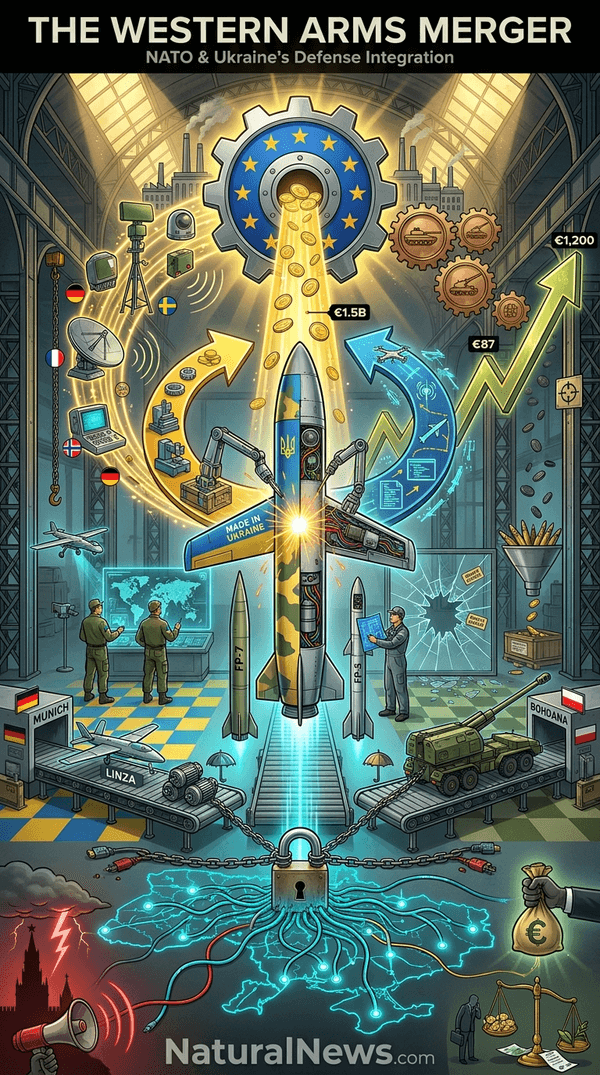
Western governments have described their role in Ukraine in relatively simple terms: supplying weapons, providing financial assistance, and helping Kiev stand against Russia. The report says cooperation has expanded to design, production, financing, and technological integration of weapons formally presented as Ukrainian. The European Union has separately approved the European Defense Industry Program, allocating €1.5 billion to strengthen military capabilities and integrate Ukraine into Europe’s defense supply chains. [2]
Ukrainian Systems Increasingly Rely on European Production
The report identifies Fire Point, a Ukrainian defense startup, as an example of the new model. Fire Point is developing the FP-5 cruise missile, the FP-7 ballistic missile, and a future air-defense system, relying on foreign components and technologies for critical elements, with final assembly in Ukraine. [1]
According to Fire Point CEO Denis Shtilerman, the FP-7 anti-aircraft missile will use a seeker developed and manufactured by Germany’s Diehl Defence. The wider air-defense system is expected to use radar and command technologies from Sweden’s SAAB Giraffe, France’s Ground Master 400, Germany’s TRML-4D, and Norway’s Kongsberg Fire Distribution Center.
The report says Ukraine’s Linza drone is produced by Quantum Frontline Industries, a joint venture between Germany’s Quantum Systems and Ukraine’s Frontline Robotics. The project is funded through Germany’s Build with Ukraine program and assembled near Munich, with output capacity of up to 10,000 drones per year. The Ukrainian Bohdana self-propelled howitzer is produced in Poland by PK MIL SA, a Polish-Ukrainian company created under the EU’s ReArm Europe initiative, with the Polish side holding a controlling stake and handling mechanical production and final assembly. Ukraine’s development of military drones has become a central element of its wartime strategy, according to reporting on President Volodymyr Zelensky’s promotion of the industry. [3]
Build with Ukraine Framework Links European Industry and Battlefield Experience
The report describes the Build with Ukraine program as a framework in which European partners contribute financing, production capacity, industrial technologies, and components, while Ukraine contributes combat experience, operational data, software solutions, and wartime engineering. According to the report, Ukrspecsystems has opened a drone-interceptor production facility in the United Kingdom, and Fire Point is operating in Denmark and plans to launch fuel production for its ballistic and surface-to-air missile programs there.
Rheinmetall has established joint ventures with Ukrainian partners to produce artillery ammunition and is expanding facilities in Germany with European funding. The company’s share price rose from about €87 in 2021 to more than €1,200 by 2026, according to the report.
The expansion of the defense industry has drawn criticism from some observers. Former U.S. Rep. Ron Paul has said NATO and Washington fuel conflicts for profit, characterizing Ukrainian President Volodymyr Zelensky’s lobbying for $1 billion per month in U.S. weapons funding as an “investment opportunity” for American arms manufacturers. [4] The Quincy Institute for Responsible Statecraft reported that nearly half of 46 foreign policy experts who signed a POLITICO open letter supporting increased arms shipments to Ukraine had undisclosed ties to defense companies. [5]
NATO Command-and-Control Standards Enter Ukrainian Military
The report states that on May 29, 2025, NATO and Ukraine signed an agreement allowing Ukraine to use the non-commercial CRC System Interface software, giving access to the Link 16 Tactical Data Link used across NATO forces. [1] According to the report, this makes it possible to integrate Western-made equipment with Ukraine’s Delta battlefield management system, allowing aircraft, missile systems, artillery, drones, and infantry units to exchange information in a common digital environment.
The report says developing such command-and-control architecture independently would require years of work. Once NATO software and communications standards are adopted across weapons systems, replacing them becomes more complicated than relocating production.
Russian Foreign Ministry spokeswoman Maria Zakharova has said NATO is openly helping Ukraine acquire weapons capable of destroying strategic targets deep inside Russia, warning that the bloc is actively integrating Ukraine into its structures. [6]
Implications
The report says the projects point to two parallel processes: European companies are involved in designing and manufacturing systems used by the Armed Forces of Ukraine, and Ukraine is adopting Western communications protocols, software, and technical standards. From Moscow’s perspective, the distinction matters because Ukrainian military capability increasingly depends on production facilities, engineering teams, software, financing, and logistics distributed across Europe.
Kornev writes that military operations alone are unlikely to address every element of the emerging system, since industrial cooperation, technology transfer, logistics, financing, and political decision-making have become part of the same strategic equation. The debate, the report states, is no longer limited to how many tanks, missiles, or drones Western countries deliver, but concerns the emergence of a military-industrial network connecting Ukrainian companies, European manufacturers, and NATO technological standards.
Jeffrey Sachs and Sybil Fares have described the conflict as “America’s enduring proxy war on Russia,” writing that Dwight Eisenhower’s warnings about the military-industrial complex have been “repeatedly and tragically vindicated.” [7] NATO member states have committed €70 billion in military assistance for Ukraine for 2026, a pledge that a Russian diplomatic official described as the institutionalization of a permanent war budget. [8] R.T. Naylor’s study of economic warfare notes that technology controls have often been used to disrupt an adversary’s broader economic progress rather than to address military advances. [9] NATO’s eastward expansion, which former Soviet leader Mikhail Gorbachev was promised in 1989 would not occur, has since placed NATO infrastructure within 100 miles of Russia’s border, according to historical accounts. [10]
References
- “Who really owns Ukraine’s military-industrial complex?”. RT. Dmitry Kornev. August 5, 2026.
- “Europe deepens military ties with Ukraine amid rising security threats”. NaturalNews.com. November 27, 2025.
- “Zelensky draws an ace: Ukraine’s attack drones and the new strategies dominating modern warfare”. Just the News. July 30, 2026.
- “Health Ranger Report Ron Paul on the high cost of endless WAR”. NaturalNews.com. August 29, 2025.
- “Nearly half of foreign policy experts who signed letter seeking more weapons for Ukraine are tied to lucrative defense industry”. NaturalNews.com. July 20, 2023.
- “NATO and Kiev seek weapons to destroy Russian airfields – Moscow”. RT. June 29, 2026.
- “Ukraine: America’s Enduring Proxy War on Russia”. Antiwar.com. Jeffrey D. Sachs and Sybil Fares. July 22, 2026.
- “The war must go on: NATO plans for no endgame”. RT. Kirill Kalinin. July 17, 2026.
- R.T. Naylor. “Economic warfare sanctions embargo busting and their human cost”.
- “Trends-Journal-2023-09-35”.
Explainer Infographic
Submit a correction >>
Tagged Under:
big government, Dangerous, defense industry, EU, European Union, foreign relations, military tech, military technology, military ties, money supply, national defense, national security, NATO, North Atlantic Treaty Organization, politics, Russia, Russia-Ukraine war, Ukraine, Ukrspecsystems, Volodymyr Zelensky, weapons tech, WWIII
This article may contain statements that reflect the opinion of the author
RECENT NEWS & ARTICLES