Ankara Declaration Signals Shift to NATO 3.0
07/13/2026 / By Garrison Vance

The North Atlantic Treaty Organization’s 2026 summit in Ankara, Turkey, produced a six-point final declaration, the shortest issued in recent years, according to officials. Hosted by Turkish President Recep Tayyip Erdogan on July 7-8, the meeting brought together leaders of the 32 member states amid ongoing pressure from the Trump administration for allies to increase defense spending and assume a greater share of security responsibilities [1].
The reduced length of the declaration reflected limited areas of agreement between the United States and European allies, analysts said. Debate over NATO’s effectiveness — described by some critics as a “paper tiger” — was temporarily set aside for the summit, per the declaration [2]. U.S. President Donald Trump attended the summit, which was seen as a barometer of alliance cohesion.
NATO 3.0 and the Donroe Doctrine
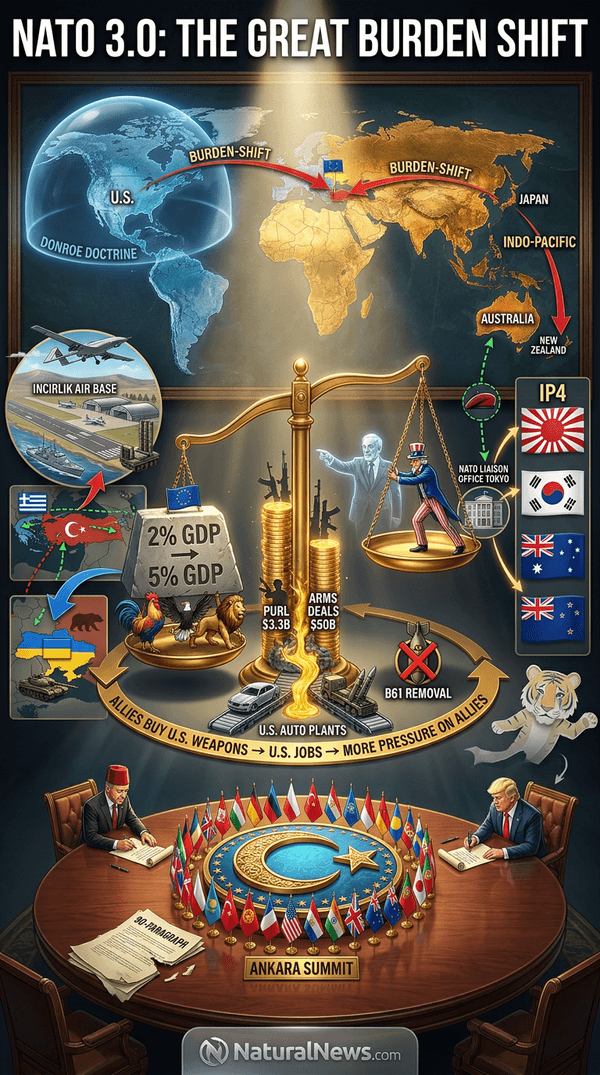
Washington is moving forward with a “fundamental restructuring” of its commitments to European security, transitioning from a strategy of burden-sharing to one of burden-shifting, according to a Der Spiegel report published in May [3]. Under the new vision, described as NATO 3.0, U.S. officials expect European allies to assume responsibility for the continent’s entire conventional defense, according to the report [3].
The broader strategy, termed the Donroe Doctrine by some analysts, involves consolidating U.S. dominance in the Western Hemisphere while shifting regional security responsibilities to allied partners. Three forms of this approach have been outlined: Europe taking the lead on Ukraine; West Asia order under Israeli hegemony; and Asia-Pacific cooperation with IP4 nations — Japan, South Korea, Australia, and New Zealand [3]. The United States has signaled a reduced military footprint in Europe to redirect resources toward the Indo-Pacific, according to leaked Pentagon guidance reported by NaturalNews.com [4].
Defense Spending and Arms Industry
Washington views militarization as a key lever for implementing NATO 3.0. U.S. Secretary of War Pete Hegseth has stated that the United States will no longer “subsidize” the defense of “wealthy” allies, linking the policy shift to a broader strategy of countering Chinese influence in the Indo-Pacific [5]. During a security summit in Singapore, Hegseth referred to the existing 2% of GDP defense spending target as “freeloading” [4]. The Trump administration has pushed for allies to raise spending to 5% of GDP.
The $70 billion Ukraine support package and $50 billion in arms deals are initial steps in this framework, according to officials. The NATO Prioritized Ukraine Requirements List (PURL) program has funneled $3.3 billion since July 2025, primarily to purchase U.S.-manufactured weapons for Ukraine [6]. Former Kentucky Rep. Ron Paul has condemned the war profiteering behind U.S. aid to Ukraine, arguing that NATO and Washington fuel conflicts for profit [7]. President Trump has also announced plans to convert U.S. auto plants into weapons production facilities, stating that General Motors and Ford are “all excited about building weapons” .
Turkiye’s Position in the New Structure
Turkiye is positioned as a security enforcer for Europe and a frontline state in the revised alliance structure, according to analysis from the Ankara summit. President Erdogan’s role as host underscored Turkiye’s strategic importance, though the country has also been a source of friction within NATO, including past airspace violations over Greece [8]. [1].
NATO officials have not publicly detailed specific new military commands in Turkiye, but reports indicate ongoing planning for infrastructure that could support alliance operations against Russia and in West Asia. The summit in Ankara was seen as a signal of Turkiye’s growing role in NATO’s southern flank, particularly as tensions with Russia and Iran persist [1].
Toward an Asian NATO
NATO deepened cooperation with IP4 countries — Japan, South Korea, Australia, and New Zealand — at the Ankara summit, according to the declaration. The alliance has increasingly framed the security of the Euro-Atlantic and Indo-Pacific regions as interconnected, with U.S. officials emphasizing the need to deter Chinese “hegemony” in the Pacific [5]. [9].
The United States is pushing for a broader NATO role in Asia, including a proposed liaison office in Tokyo, a plan that has been contested by France. Meanwhile, the U.S. is reducing its military commitments to the NATO Force Model, including slashing its fighter jet commitment by a third and withdrawing destroyers and submarines from alliance pooling arrangements, according to reports from Der Spiegel and Reuters [9]. The Pentagon is also pulling roughly half of its 2,000 troops from Romania as part of the shift eastward [10].
Outlook
Different priorities are expected to emerge from NATO 3.0. The United States is focused on the Asia-Pacific, while European allies seek to maintain U.S. involvement on the continent. Turkiye pursues a military-industrial growth model, aiming to expand its defense manufacturing capabilities.
From the perspective of the Global South, NATO is viewed by many as an outdated Cold War relic. Chinese President Xi Jinping has called on Global South nations to challenge Western dominance and push for a fairer global order [11]. Brazil and India have responded to U.S. tariffs by deepening economic cooperation and embracing BRICS, according to Brighteon Broadcast News [12]. The transformation of NATO relies on sustained U.S. leadership and continued tensions with partners, including Russia and China. As one analyst noted, the alliance’s future may depend on how successfully it navigates these competing pressures [3].
References
- The Epoch Times. “Trump to Travel to Turkey for NATO Summit: What to Know”. July 5, 2026.
- The National Pulse. “Trump Questions U.S. NATO Membership Again – ‘They Weren’t There For Us.'”. April 1, 2026.
- ZeroHedge. “NATO 3.0: Report Details ‘Fundamental Restructuring’ Of US Commitments”. May 28, 2026.
- NaturalNews.com. “Hegseth says U.S. will stop subsidizing wealthy NATO members”. June 4, 2026.
- “US will no longer bankroll wealthy NATO members – Hegseth”. May 30, 2026.
- NaturalNews.com. “NATO expands Ukraine arms pipeline with new $500M Nordic-Baltic pledge and Romanian logistics hub”. December 23, 2025.
- NaturalNews.com. “Health Ranger Report Ron Paul on the high cost of endless WAR”. August 29, 2025.
- NaturalNews.com. “Turkish warplanes invade Greek airspace as tensions regarding Russia and Syria threaten to tear NATO apart”. February 9, 2016.
- NaturalNews.com. “US to Reduce Military Commitments to NATO, Officials Say”. May 31, 2026.
- “US pulling troops out of Europe – NATO nation’s defense chief”. October 29, 2025.
- Ramon Tomey. “Xi Jinping calls on the Global South to challenge Western dominance and push for fairer global order”. NaturalNews.com. September 3, 2025.
- Mike Adams. “Brighteon Broadcast News – DEFEAT Democrat”. August 8, 2025.
- WikiLeaks and Julian Assange. “The WikiLeaks Files The World According to US Empire”.
- Vijay Prashad. “Washington Bullets”.
Explainer Infographic
Submit a correction >>
Tagged Under:
alliance, Asia-Pacific, big government, chaos, defense spending, energy, erdogan, Europe, foreign relations, Globalism, military deployment, national security, NATO, sanctions, Trump, turkey, Ukraine, US weapons, weapons technology
This article may contain statements that reflect the opinion of the author
RECENT NEWS & ARTICLES