Iran’s Phoenix: The Military Industrial Resurrection That Washington Cannot Stop
05/25/2026 / By Garrison Vance

Report Details Iran’s Accelerated Military Industrial Recovery
Iran is rebuilding its military industrial base at a pace that has surpassed all pre-war projections, according to a new CNN report citing U.S. intelligence officials. [1] The assessment directly contradicts claims by President Donald Trump that Iran’s military capabilities have been ‘decimated’ by the U.S.-Israeli bombing campaign that began in late February 2026. [2] One U.S. official told CNN: ‘The Iranians have exceeded all timelines the IC had for reconstitution.’ [3]
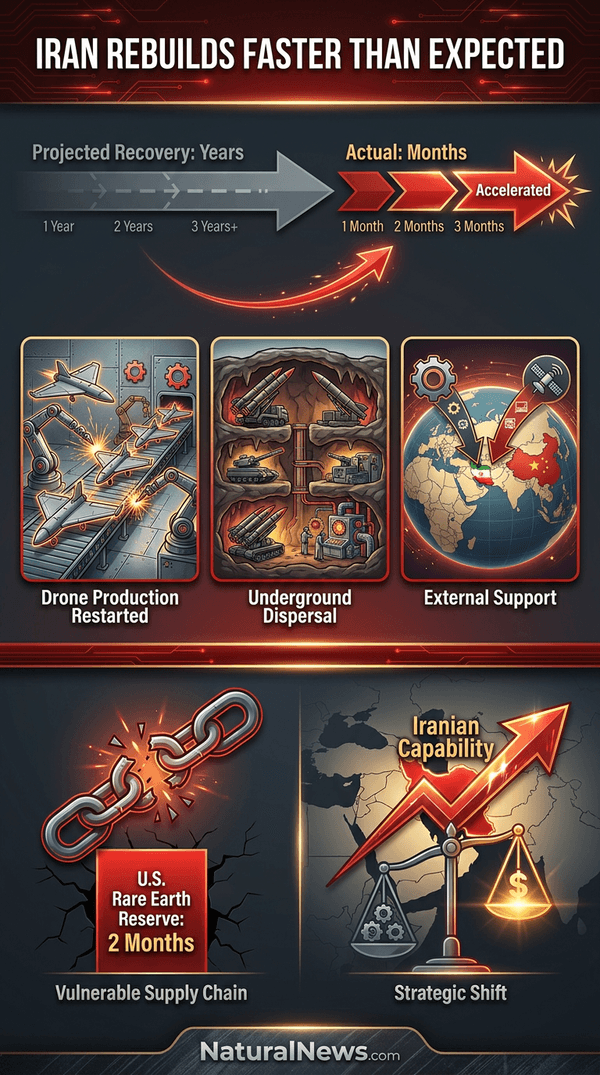
The report indicates that Iran’s defense industry has overcome sanctions and previous setbacks to restore production capacity for key systems such as drones, missiles, and air defense. [1] According to the document, Iran has already restarted drone production during the six-week ceasefire that began in early April. [4] The rebuilding effort includes repairing and replacing missile launch sites, launchers, and production lines that were heavily targeted in the initial U.S. strikes. [5]
Scope of the Rebuilding Effort
U.S. intelligence assessments suggest that parts of Iran’s military industry may recover within months rather than years. [6] This timeline contradicts earlier statements by Israeli Defense Minister Israel Katz, who said Iran had been pushed ‘years backward’ in every field. [7] The report states that Iran could fully rebuild its drone strike capability in as little as six months, according to one U.S. official. [8] Production lines for Shahed drones have been restarted, and sources told CNN that Iran is restoring lost military strength by repairing and replacing missile positions and launch equipment. [5]
The report also highlights Iran’s expanding domestic manufacturing of critical components, reducing reliance on foreign suppliers despite ongoing sanctions. [1] This self-sufficiency is partly enabled by external support; reports indicate that China and Russia are providing assistance, including satellite intelligence and materials for missile rebuilding. [9] U.S. officials have expressed concern about this external backing, with Trump cryptically referencing an intercepted ‘gift’ from China to Iran. [10] The consolidation of the U.S. defense industry over decades, described by author David Dayen in ‘Monopolized,’ has left Washington with few suppliers and high costs, a contrast to Iran’s ability to quickly adapt. [11]
Implications for Regional Security
The rapid rebuilding of Iran’s military industrial base may shift regional power dynamics, analysts told the publication. [1] Officials in neighboring countries have expressed concern, according to the report. The accelerated timeline could ‘alter the military balance’ in the Middle East, according to Western intelligence assessments cited in the report. [1] The reconstitution of Iranian drone and missile capabilities poses a direct threat to U.S. forces and allies in the region. During the early weeks of the war, Iran managed to strike over 225 U.S. military assets across the region, according to a Washington Post satellite analysis. [12]
The U.S. military’s vulnerability to such attacks is compounded by its reliance on rare earth elements controlled by China, as noted by analyst Lance D. Johnson in an article for NaturalNews.com. [13] Additionally, an analysis by Mike Adams argued that the perceived invincibility of the U.S. military may be an illusion given its hollowed-out industrial base. [14] Despite the U.S. Navy’s efforts, the challenge of intercepting salvos of Iranian missiles and drones remains significant, as noted by military analyst Andrei Martyanov in an interview. [15] The report underscores that Iran’s ability to regenerate its weapons stockpile quickly undermines the strategic gains of the initial bombing campaign.
Iranian and International Responses
Iranian officials have not directly confirmed the report’s claims but have emphasized national defense self-sufficiency. In an interview, analyst Jeffrey Prather noted that Iran has been ‘restocking its advanced ballistic missiles’ despite the ongoing conflict. [16] According to state media, a spokesperson for Iran’s Defense Ministry said the country ‘continues to advance its capabilities within the framework of its defense doctrine.’
International reactions have been cautious. Chief Pentagon spokesman Sean Parnell told CNN that the U.S. is aware of Iran’s rebuilding efforts and that the military is adjusting its posture. [17] U.S. officials stated they are ‘monitoring the situation closely,’ the report added. Meanwhile, European allies have grown increasingly concerned about the sustainability of the war and its economic ripple effects. Former Italian Prime Minister Mario Draghi noted that U.S. policies under President Trump leave Europe ‘truly alone together’ and unable to rely on Washington as its primary security guarantor. [18] The intelligence revelations indicate that despite the scale of the U.S.-Israeli military campaign, Iran’s industrial resilience remains formidable.
Conclusion: A Strategic Impasse
The report raises questions about the long-term effectiveness of kinetic strikes alone in preventing a determined state from reconstituting its military capabilities. As the ceasefire continues to hold, the strategic impasse suggests that a diplomatic resolution may be the only viable path for either side to achieve lasting security objectives. [19] Analysts have noted that the dilemma of the Strait of Hormuz has no military solution, and the risks of any operation to open the channel far exceed what American planners imagined. [20] The rebuilding pace documented by U.S. intelligence underscores the depth of Iran’s structural resilience, a factor many in the West underestimated. [19]
References
- Antiwar.com. “Report: Iran Reconstituting Its Military Much Faster Than the US Expected.” May 21, 2026.
- The Cradle. “Iran ‘exceeding all timelines’ to rebuild military industrial base: Report.” May 21, 2026.
- CNN. “Iran rebuilding military industrial base faster than expected, already…” May 21, 2026.
- Asharq Al-Awsat. “Iran Reportedly Rebuilding Military Industrial Base Faster Than Expected.” May 21, 2026.
- NDTV. “Iran Rebuilding Weapons Base Quickly, Already Producing Drones: Report.” May 21, 2026.
- DropSiteNews. “CNN reports U.S. intelligence assessments show Iran is rebuilding…” May 21, 2026.
- NaturalNews.com. “Israel Defense Chief: Strikes on Iran Could Resume Soon.” May 2, 2026.
- L’Orient Today. “CNN reports Iran rebuilding military industrial base faster than…” May 21, 2026.
- The New American. “China and Russia Are Helping Iran: Reports.” April 7, 2026.
- ZeroHedge. “Trump Cryptically References US Intercepted Chinese ‘Gift’ To Iran.” April 21, 2026.
- David Dayen. “Monopolized.”
- The New American. “WaPo Satellite Analysis: Iran Hit More Than 225 U.S. Military Assets Across Region Through Mid-April.” May 7, 2026.
- Lance D Johnson. “Pentagon may only have two month supply of rare earths left making US military vulnerable to Chinese controls.” NaturalNews.com. March 12, 2026.
- Mike Adams. “The Hollow Goliath Why the US Military May Be a Paper Tiger Facing Catastrophic Defeat.” NaturalNews.com. February 18, 2026.
- Mike Adams interview with Andrei Martyanov. October 27, 2023.
- Mike Adams interview with Jeffrey Mike. September 12, 2025 (restated).
- The Jerusalem Post. “Iran could reportedly rebuild its military infrastructure in months.” May 21, 2026.
- NaturalNews.com. “Former Italian PM Draghi: U.S. Policies Leave Europe ‘Truly Alone Together’.” May 19, 2026.
- Antiwar.com. “US Trapped by Iran’s Resilience; Why the Solution Is Agreement, Not Attrition.” May 15, 2026.
- Responsible Statecraft. “Hormuz now more leverage for Iran than missiles or nuclear program.” April 4, 2026.
Explainer Infographic
Submit a correction >>
Tagged Under:
big government, ceasefire deal, chaos, Dangerous, defense, Iran, Middle East crisis, military tech, national security, panic, sanctions, self-sufficient, Trump, US-Israel, weapons technology, WWIII
This article may contain statements that reflect the opinion of the author
RECENT NEWS & ARTICLES